People often ask why Alaska has a housing shortage, given how much land there is. The issue isn’t land; it’s feasibility.
I have lived here my whole life. Over time, the gap between what it costs to build and what the market can support has widened. That gap explains much of what buyers, sellers, and renters are feeling today across the Mat-Su Valley and beyond.
What the Feasibility Gap Looks Like on the Ground
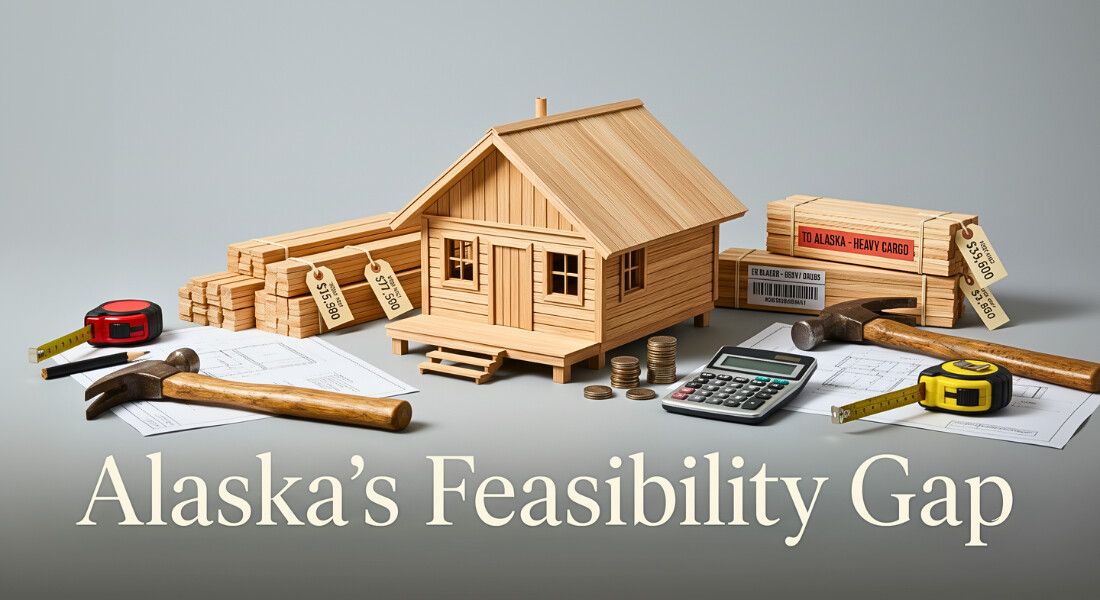
A feasibility gap exists when the cost to build a home exceeds what that home can reasonably sell or rent for.
In Alaska, that gap shows up quickly. Construction costs are high. Labor pools are smaller. Materials travel long distances by barge or truck. Fuel prices fluctuate. Weather compresses building seasons.
By the time a home is finished, the numbers often do not pencil out. It is especially true for entry-level and workforce housing. If you are waiting for a wave of inexpensive new homes, the math is working against that outcome.
Open Land Does Not Automatically Mean Lower Prices
It is easy to look at open space around Palmer, Wasilla, or Big Lake and assume housing should be cheaper.
Raw land still needs roads, utilities, drainage, and permits. Septic and well costs add up quickly. In winter-heavy regions, site work can exceed expectations before framing even starts.
Land is only one line item. In Alaska, it is rarely the deciding one. Affordability depends far more on infrastructure and build costs than acreage alone.
The Reality of Construction Costs and Labor
Builders here compete for a limited labor force. Skilled trades are in demand year-round, and wages reflect that reality.
Materials present another challenge. Shipping adds time and cost. Delays ripple through schedules, and a missed barge can mean weeks of lost time.
None of these is a matter of inefficiency or mismanagement. It is simply the reality of building in a remote, seasonal market. New construction pricing reflects real constraints, not inflated margins.
Why Modular Housing Is Not a Cure-All
Many people assume modular housing should close the gap. It often does in other states. In Alaska, shipping changes everything.
Transporting large modules is expensive and complex. Weather windows matter. Staging sites are limited. By the time units arrive and are set, much of the expected savings has disappeared.
Modular housing can still make sense in specific situations, but it is not the universal solution many expect.
A Snapshot From the Mat-Su Valley
A few winters ago, I walked a nearly finished home outside Wasilla with a local builder. Snow was packed hard around the foundation. Framing was complete, and mechanical rough-ins were underway.
On paper, it was a modest three-bedroom home. Nothing flashy. Built for a local household.
Once we added up labor, materials, shipping, site work, and carrying costs, the builder was already tight. One more delay would have pushed the project underwater.
That household eventually moved in. The home was appraised and sold. But the margin was thin enough that the builder paused future projects.
That story repeats quietly across the Valley. No one is being dramatic. It is simply the reality of building homes here.
How the Feasibility Gap Pressures the Rental Market
When new homes do not get built, pressure shifts to rentals.
Landlords face the same construction and maintenance costs as owner-occupants. Insurance, repairs, and utilities do not drop simply because a unit is rented.
Rents rise because of math, not motive. Owners have to cover real expenses. That is why rental availability remains tight in growing areas, even when demand feels steady rather than explosive.
What Buyers Often Miss
Buyers sometimes expect prices to fall sharply when headlines turn negative.
The feasibility gap puts a floor under values. If it costs more to build new than to buy existing, prices tend to hold. Inventory stays limited. New construction is not always cheaper, and well-maintained homes remain competitive.
Timing the market becomes harder when replacement costs stay high.
What Sellers Tend to Overlook
Sellers often worry they missed the peak.
In reality, replacing a functional, well-kept home is difficult and expensive. That supports long-term value, especially for updated, efficient homes located near services.
Condition and usability matter more than market noise.
Common Questions About Alaska’s Housing Costs
Why does Alaska have a housing shortage despite abundant land?
Because land is only one factor. Infrastructure, labor, materials, and logistics drive total costs, and they are high here.
Is the feasibility gap unique to Alaska?
No, but it is more pronounced in remote and seasonal markets. Alaska combines both.
Will modular housing eventually solve the problem?
It can help in specific cases, but shipping and setup costs limit broad affordability gains.
Do higher rents mean landlords are overcharging?
Often no. Rents usually reflect real ownership costs, including maintenance and insurance.
Will prices fall if demand slows?
Prices can soften, but high replacement costs tend to limit sharp declines.
Is building new a bad idea right now?
Not necessarily. It depends on location, design, and expectations. Feasibility matters more than timing.
Does this affect investors differently from homeowners?
Yes. Thin margins leave little room for error, which makes careful analysis essential.
Before You Make Your Next Move
Alaska’s housing challenges are not about a lack of space. They are about costs, logistics, and economics that do not bend easily.
If you want to pressure-test a decision before committing, talk with someone who understands how these numbers work in Alaska. Contact us to walk through your options with clear expectations and fewer surprises.